
Imagine you're part of a decentralized lottery. A cryptographic function decides if you're the winner. You prove your eligibility with a random-looking output that only you could have generated. This is the power of a VRF — and today, we’ll explore how adding context through additional data (AD) makes it even more secure and versatile.
In this blog we’ll cover:
- What is a Verifiable Random Function (VRF)?
- What is Additional Data (AD)?
- Why does AD matter in modern cryptographic protocols?
- How does VRF-AD work?
- Real-world use cases and examples
What is a Verifiable Random Function (VRF)?
A Verifiable Random Function (VRF) is like a cryptographic hash function, but with a twist: it's keyed. Only someone with a secret key can generate a value, but anyone with the public key can verify it was done correctly.
Key Properties:
- Deterministic: Same input always yields the same output
- Pseudorandom: Output looks random to everyone else
- Verifiable: Comes with a proof that anyone can check
Use Cases:
- Leader election in blockchains (e.g., Algorand)
- DNSSEC (NSEC5)
- Randomness in smart contracts (e.g., Chainlink VRF)
Limitations of Traditional VRFs
While VRFs are powerful, they have limitations:
1. Replay
Without binding to context, someone could reuse a valid output + proof in a different domain or application.
2. Lack of Domain Separation
The same input used in two different systems could produce the same output and proof, potentially leaking data or leading to misuse.
3. Insecure in Privacy-Preserving Systems
Protocols like zero-knowledge proofs or ring VRFs need stronger proof binding to ensure anonymity and contextual correctness.
Introducing VRF with Additional Data (VRF-AD)
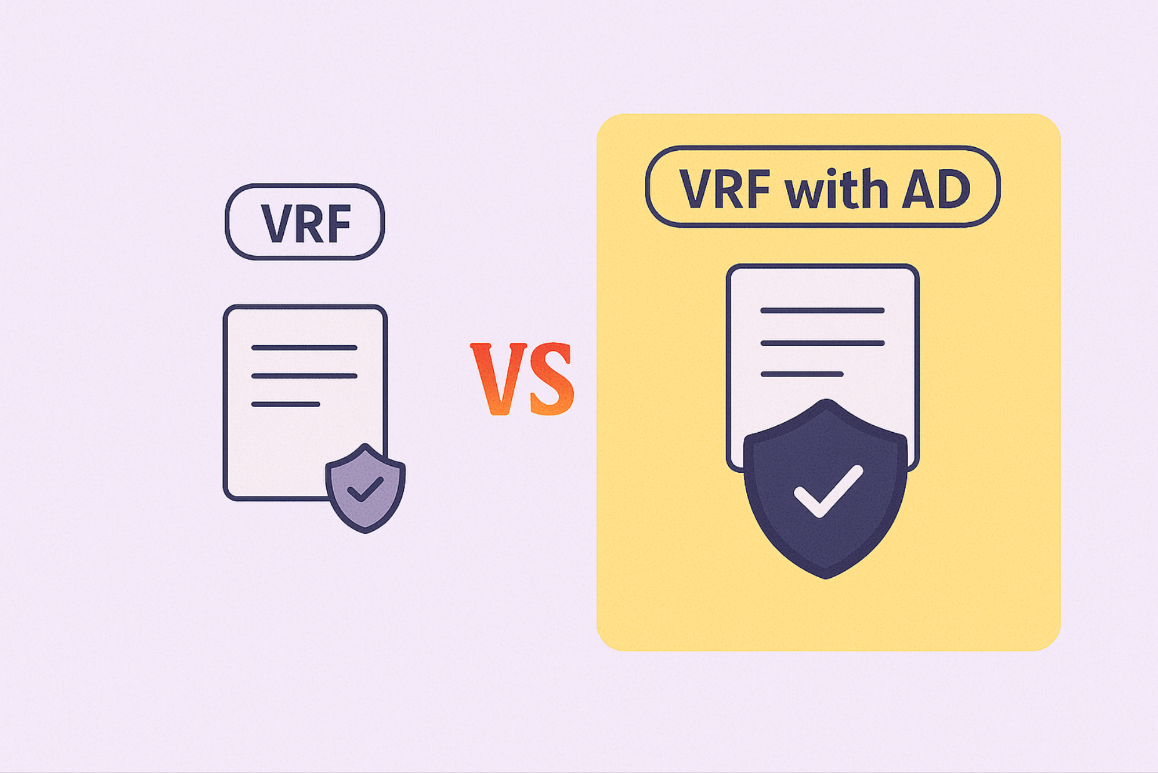
VRF-AD enhances the classic VRF by allowing users to include contextual metadata — called “additional data” or AD — into the verifiable proof.
What's Different?
- The VRF output remains the same
- The proof is now bound to both the input and the additional data
This ensures the proof is only valid within the given context.
Why Add Context? The Benefits
Context Binding
Proofs are now tightly linked to the context they were created for (e.g., "election-2025").
Replay Protection
Even if someone captures a valid output and proof, they cannot reuse it in another domain or application.
Domain Separation
Same input string yields unique proofs in different applications.
Enhanced Privacy
Essential for protocols involving anonymity, such as ring signatures and zero-knowledge VRFs.
How VRF-AD Works
Let’s walk through the simplified process:
1. Input Conversion
I = hash_to_curve(input)
This maps the input to a point on the elliptic curve.
2. Output Generation
O = sk * I
This scalar multiplication produces the VRF output.
3. Proof Construction
The proof π is generated using the input and the additional data:
π = Prove(sk, input, ad)
4. Verification
Verify(pk, input, ad, output, π)
The verifier checks the proof is valid for both the input and the context.
Real-World Examples
JAM (Join- Accumulate Machine)
In JAM, VRF-AD technology will be crucial for:
- Ensuring fair participation in decentralized consensus
- Verifiable randomness for selection processes
- Preventing manipulation through contextual binding
- Enhancing privacy in user interactions
ZK Voting Systems
Privacy-preserving voting protocols use Pedersen or Ring VRFs with AD to ensure anonymous yet verifiable participation.
Conclusion
As cryptographic functions become foundational across layers of digital infrastructure — from randomness to identity and privacy — adding context is no longer optional. VRF-AD offers a simple yet powerful upgrade that makes VRFs safer, more flexible, and future-proof.